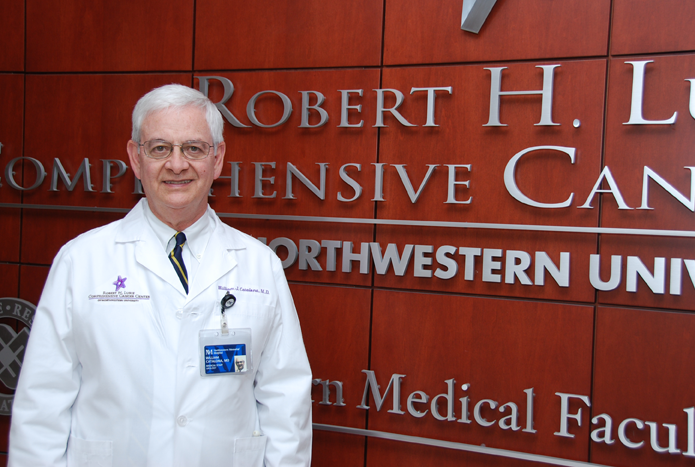
Should men undergo regular prostate cancer screenings? A new report says no. One of the leading proponents of the PSA test is here to tell us why he thinks the recommendation is dead wrong. Dr. William Catalona joins us on Chicago Tonight at 7:00 pm.
Do you think regular prostate cancer screenings are beneficial? Post your comments below or sound off on our discussion board!
Daily coverage delivered to your inbox


Comments
Prostate cancer screening
Eliminating PSA screening for prostate cancer detection would be an incredible step backward, condemning many thousands of men to prolonged suffering and painful deaths after their cancers were discovered "too late". Yes, I'm living with some of the side effects of surgery, having decided my prostate would be removed following cancer detection based on PSA screening. If left untreated into the future, I may or may not have died from this cancer as did my 89 year-old grandfather, but as a result of PSA screening I'm glad I became equipped with the knowledge to balance the risks and assess treatment options with a mind to accepting the range of outcomes. The absolute worst case is to be blinded to the possible existence of such a problem, particularly when driven by recommendations coming out of government sponsored panels only interested in making value judgements for the population as a whole.
Prostate Cancer Screening
I enjoyed hearing both sides of the arguement, pro and con for PSA screening. But what about preventative measures? It always seems that in the healthcare field its about reacting to a disease, rather than trying to prevent the disease from ever occuring in the first place. You now need to have a professional health practitioner discuss preventing prostate cancer to balance out the discussion.
Regular Prostate Cancer Screening
The argument—that men over 40 should no longer engage in regular PSA screening in order to avoid unnecessary treatment and its significant complications—is misdirected. If the laudable goal is to avoid unnecessary treatment of early stage indolent prostate cancer and the corollary of unnecessary impotence/incontinence complications, it is illogical to argue that the solution lies in the elimination of routine PSA screening which can detect prostate cancer in its earliest stages of development. Analogously, if the goal is to avoid unnecessary firefighting tactics and the corollary of unnecessary water damage in the extinguishment of incipient, smoldering waste can fires, it is illogical to argue that the solution lies in eliminating the routine use of smoke detectors which can detect fire in its earliest stages of development. Both of the arguments are invalid because they incorporate contain a post hoc fallacy (namely, since "x" is followed by "y" - then "x" is the cause of "y"
The problem is NOT routine PSA screening (which is simple and fairly inexpensive), but rather the hysteria and resultant rush to standard surgical or radiation treatments (which are expensive and laden with significant potential complications). PSA screening (via elevated levels in the blood) detects early stage prostate problems (both cancerous and non-cancerous), thus avoiding having to wait for actual symptoms of prostate cancer to appear (which typically occur only when the disease is its late stages) in order to initiate diagnostic testing. If biopsies of the prostate reveal the presence of cancer cells, PSA readings then also provide significant additional information to that attained from the biopsies themselves (number of positive samples found, percent of aberrant cells, Gleason scoring), as to the degree of aggressiveness of the cancer (PSA level, PSA velocity, PSA density, percent free PSA). It has been determined that most diagnosed prostate cancer in patients is typically an indolent rather than an aggressive form, which means that it it is very slow growing and thus most patients would die WITH the disease rather than OF the disease. Postmortem autopsies of elderly men have revealed that many had prostate cancer (symptom-free and undiagnosed). Consequently, a countervailing perspective has developed in early stage prostate cancer management (alternately termed "active surveillance" and "expectant management") that avoids/delays any treatment (an its attendant complication risks) unless and until careful monitoring indicates signs of the more rare aggressive form of the disease beginning to manifest itself. And a critical component of that monitoring is the PSA test (PSA level, PSA velocity, PSA density, percent free PSA).
And so a more proper chain argumentative presents itself. Regular PSA screening enables early detection of potential prostate problems (possibly cancer, possibly not), thus indicating the need for a biopsy procedure to make a diagnosis one way or another. If the biopsy analysis proves positive for early stage prostate cancer and repeat PSA results continue to confirm that it is the most common indolent ("idle" or "lazy") form of the disease, then delay or perhaps even avoidance of undergoing unnecessary treatment with its potential serious complications becomes a conditional management possibility through active surveillance (which continues to include regular PSA assessment). It is regular PSA screening that initiates this best overall scenario for managing prostate cancer should it be present, without waiting for alerting symptoms indicative of later stages of the disease. By creating early awareness of having prostate cancer in its earliest stages, it allows for an active surveillance option, thereby providing both time (especially after the emotions subside) and motivation for making unhurried, informed decisions along the way by becoming educated about: (a) the nature of the disease, (b) the positive and negative aspects of various treatments (including new, less hazardous management options currently in clinical stages of being researched), and (c) lifestyle changes (diet, exercise, supplements) that can enhance prevention of the disease developing into its more aggressive form. With proper monitoring, all options for appropriate treatment continue to remain open (plus the additions of increasingly new options on the horizon), as well as the option for no treatment should the disease fail to show evidence of progressing to any significant degree (and it is continued regular PSA testing provides much of that evidence).
As Dr. Catalona stated in the Chicago Tonight interview, "knowledge is power." Having greater control and having maximum number of options is indeed having power. Having early knowledge that one has prostate cancer gives the patient the greatest power to make informed decisions about IF to treat, WHEN to treat, and HOW to treat, all within a controlled, unhurried time frame. At the present time, the first crucial step in being knowledgeable about one's prostate health, is regular PSA screening. Reducing unnecessary treatment and unnecessary risk of complications is best accomplished by a recommendation for a standard management paradigm that encourages placement of indolent early stage prostate cancer patients into "active surveillance" programs which closely test (regularly scheduled followup PSA screening, digital exams and biopsies) and monitor for changes in aggression (according to threshold criteria similar to that established at Johns Hopkins), indicating the need to shift into a treatment regimen.
Avoiding a Death Sentance
In 2002, the British Ministry of Health sent every GP a: Prostate Cancer Risk Management Pack the only problem being, that the GP's did not pass on the information to their older, male, patients. British government has denied men in the UK access to Prostate Cancer Screening since 1987. It is probable that the people responsible for those two situations do not have a Prostate problem or, they are having regular PSA tests themselves. The one certainty is, that at least 140,000 men have died needlessly since 1987. I use my self as an example as to what happened after the GP's were given 'information packs' nine years ago. Through 2008, I saw four GP's at the same surgery with ever increasing pain in the lower back, which spread to the hips, legs and feet. In January, 2009, a fifth GP at the same surgery immediately gave me an examination for a Prostate problem and four days later, Advanced Prostate cancer had been diagnosed PSA 950 Gleeson 4+4 - too late for me. Now I tried; I really tried through 2008 to get a diagnosis - to no avail. Prostate cancer screening would have saved me and the other 9,999 men who will die with me in the near future. This arguing backwards and forwards about screening is an absolute nonsence. The death sentence was banished in Europe years ago - no it wasn't - as 10,000 men will find out each year in the UK if screening for Prostate cancer is not started - one man every hour dying needlessly; a family mourning needlessly, every hour.
Blown away by task force results!
I am a former patient of Dr Catalona. I am 45 yrs old and was diagnosed in April 2011 during a routine PSA test due to me taking testosterone supplements. It was removed via nerve sparing open radical prostatectomy. I do not see how this group can make a blanket determination like this without looking at the whole picture. They are doing a disservice to males out there with their statements. Would this task force have been willing to be the ones that would have had to tell my two teenage daughters and wife, “We are sorry but we were wrong” because I would not have been able to have caught it early enough to save my life? I think not. My Gleason before surgery was 3+3=6 and 3+4=7 after. Dr Catalona got it out just in time as it was encroaching on the prostate’s membrane.
It is my understanding that this task force didn’t even have a urologist or oncologist in the group. Is this how we are going to advance into the future? Obviously, practice does not make perfect here! With that said…Dr Catalona has now performed more than 5,000 radical prostatectomies, more than anyone else in the world. Dr. Catalona is one of the first surgeons to perform and perfect nerve- sparing surgery in radical prostatectomy operations. His patients have come from all 50 states in the United States, as well as from Asia, Europe, the Middle East, and Central and South America. Knowing this…who will you believe? ITS A NO-BRAINER FOR ME!!!
Write your Congressman
I for one think we should write our congressmen. Senator John Kerry had prostate cancer and his surgery was performed by Dr. Patrick Walsh at Johns Hopkins in Baltimore, MD. Dr. Walsh and Dr. Catalona are both very respected in this field. I would like to hear Senator Kerry's response to this task force study.
Add new comment