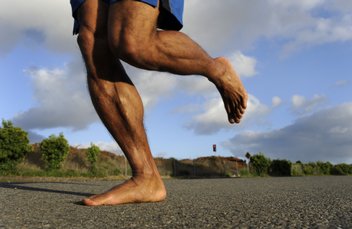
A barefoot runner makes the case for leaving your shoes at home -- even in the winter. Jay Shefsky introduces us to him on Chicago Tonight at 7:00 pm.
Chicago Tonight spoke with local podiatrists about the potential risks and benefits of barefoot running. Here is what they had to say:
Dr. Sherwin Ho, director of sports medicine at University of Chicago and associate professor of orthopedic surgery, says the idea for barefoot running came about because people naturally used to run barefoot for centuries before the invention of the running shoe.
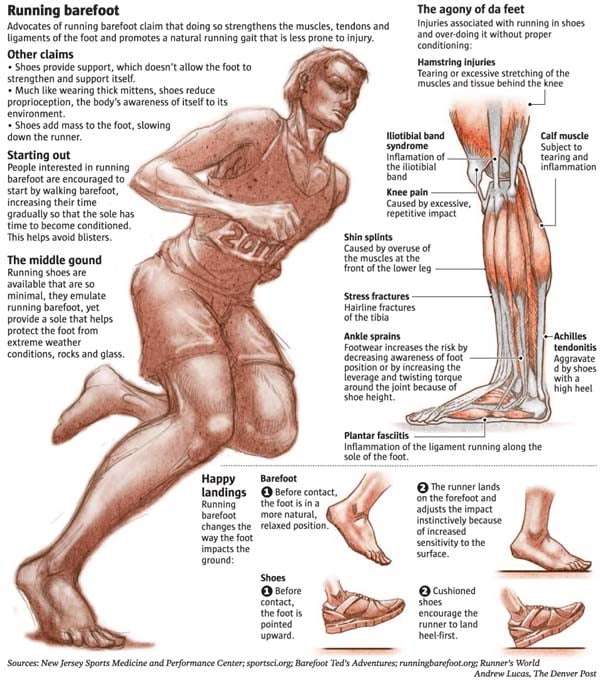
“I grew up in Hawaii and we always ran barefoot,” he said. “And you do run differently. The classic running style with modern running shoes is heel-toe: you land on your heel and push up.”
Dr. Ho says that running shoes have cushioning in the heel and sole because all of the impact when you land on your heel goes directly into the foot and knee.
“The shock absorption from running with shoes is in your knees and quadriceps,” he said.
Dr. Ho says barefoot runners have to change the way they run to land on the balls of their feet first -- or risk injury.
“When you go to barefoot running, you have to change your running gait. If you don’t, you would get stress fractures in your heel because there’s no padding in the heel,” he said.
Dr. Ho has seen patients who have switched from running with shoes to barefoot running, without changing their running style. 
“I’ve taken care of people who show up with stress fractures in the heel,” he said.
Dr. Ho also says that barefoot running adds a new shock absorber to your running gait.
“Instead of the knee absorbing all of the impact, now your ankles and calves are involved,” said Dr. Ho.
Dr. Ho says that while he doesn’t necessarily recommend barefoot running in general, some people may benefit from it.
“For people who have had multiple impact-related, stress-related injuries, barefoot running can be a better tolerated option for them. So, if someone has ran for a long time and their knee is starting to wear out, they can try barefoot running because it adds a new shock absorber. You get to use another muscle group to absorb some of the shock when you run,” he said.
Full disclosure: Dr. Ho is a sometimes-barefoot runner.
“I run barefoot sometimes and then I switch to running shoes,” he said. “I go back and forth. I like them both.”
Dr. Beth Jarrett, podiatrist and professor at Rosalind Franklin University of Medicine and Science, says that unknown roadways for barefoot runners present the real risk.
“Probably the bigger issue in terms of injuries with barefoot running is the fact that you’re barefoot, and more likely to step on stones or glass,” she said.
Dr. Jarrett says she would not generally recommend barefoot running, unless someone had access to a safe running environment to minimize the risks of injuries from unknown surfaces.
Dr. Michael Chin, sports medicine podiatrist and medical director of The Running Institute, says barefoot running is a good training tool to improve the mechanics of running, but he doesn’t recommend it for long distances.
“You can work on cadence, how fast you are legs are turning over per minute,” said Dr. Chin. “Barefoot runners use short, choppier steps versus longer strides for those running with shoes.”
Some of the injuries Dr. Chin has seen from barefoot runners are “stress factures of the bones in the balls of the foot, calf tears and Achilles tendon tears.”
“I’d recommend [barefoot running] for training but not for long distance because we’ve seen just as many injures with barefoot running as we do with regular shoes,” said Dr. Chin. “If they are fit properly and supported properly, shoes make a big difference. There’s very few people that would run 26.2 miles [a marathon distance] barefoot.”
As Dr. Jarrett says, if people are not already runners, they shouldn’t try barefoot running out of the blue.
“It’s important to remember that just as not everyone is meant to be a runner, not everyone is meant to be a barefoot runner,” she said.
Comments
Barefoot running.
Hello! My comment is about barefoot running and the specific detail the barefoot runner made during his interview. Allow my to digress for a moment: "When we examine the Animal Kingdom's best runners, all these animals run with their toes touching the ground first." This technique was adopted by our the sprint runners in Olympic Games and their running shoes were designed with spikes under the front or the toe of each running shoe for better traction. When I heard the barefoot runner comment that he allows his toe or front of his feet to hit the ground first, this made perfect sense to me. Most runners do not follow this simple design of nature as they run with their heals hitting the ground first, thus they suffer the painful consequences of an unnatural running design with feet and back problems. On this note, I'd like the Media to teach the public about the proper way to running or jugging, as I know at present these skills are not being taught in the Physical Education curriculum. Regards, Steve Horvath
barefoot running myths
“Probably the bigger issue in terms of injuries with barefoot running is the fact that you’re barefoot, and more likely to step on stones or glass..."
--This statement is incorrect. You are LESS likely to step on stones or glass because you'll be looking for it and avoiding it unlike with shoes.
“I’d recommend [barefoot running] for training but not for long distance...If they are fit properly and supported properly, shoes make a big difference."
-- This statement has no basis in fact. I've run long distances barefoot (shoeless) without incident. Yes, my transition took two years...could have been less if I knew what I know now.
Barefoot running
I already posted my Comment on the main discussion board and refer readers there. I just want to comment on the quote cited by Steve Horvath about the Animal Kingdom's best runners running with their toes touching the ground first. Most animals don't have plantigrade locomotion like humans; the joint area corresponding to the human ankle is called the "hock" in large quadrupeds like horses; obviously their "heels" can't be put on the ground during locomotion. These animals walk on their "toes" too. Humans are built for superior endurance running, not the greatest speed.
I switched to barefoot!
I switched to barefoot about a year ago. Right away it felt better on my knees and hips. It took me a while to build up my distance, and even more to stop my old shoe-wearing habits. But now, I have no problem running 5k barefoot, and haven't been injured in a year. For times where I want some extra protection, or when I'm going somewhere that doesn't allow barefoot people, I wear some sandals from http://www.invisibleshoe.com. My wife wears them too, but just because she lieks how they look. She's not a runner.
Barefoot running
Some of the comments in the article are clearly by people who haven't tried barefoot running. I would agree completely that a slow transition is necessary to minimise calf and other injuries, as greater stretch of the calf muscles and tendons is required. Also, simply to get used to the different gait, shortened stride so that the foot can land under the centre of gravity. But, this apart, the risk of injury is low. The risk of hurting yourself initially (not injuring) is higher, because it is the sensitive nerves in the feet that give the feet back and teach you to run more lightly - and to keep a good eye out for the ground ahead of you, thus avoiding all that glass which is not a real issue . I haven't yet run a marathon, with our without shoes, but have done half marathons and my feet feel better at the end than they ever could in shoes.
If you haven't run before? Don't bother with shoes, barefoot is best.
Barefoot running
I would prefer running on barefoot. At first, it was kinda awkward, but when you get used to it, the pain on the joints are lesser.
Running Technique
Excellent article - very well written. Most folks fail to realize their running technique could be improved b/c their fancy shoes with the large air cells at the heel absorb the stress of their poor technique. Run barefoot on concrete and you quickly realize whether you truly know how to run!
Barefoot Running? Try It!
I've run barefoot for 6 years in all types of weather and on all types of terrain. I love it and have averaged around 25 miles/week over this time. Want to learn more? Check out my website.
http://facebook.com
http://facebook.com/DaytonBarefoot/Runner
I'll get it right eventually
I'll get it right eventually :)
http://facebook.com/DaytonBarefootRunner
Barefoot running
I am in transition right now to barefoot running. I have some minimalist shoes that I run in about half the time. I like running barefoot and have noticed that my times are a little faster and I don't feel as sore after my runs. I hope to be completely barefoot by this summer.
Add new comment